
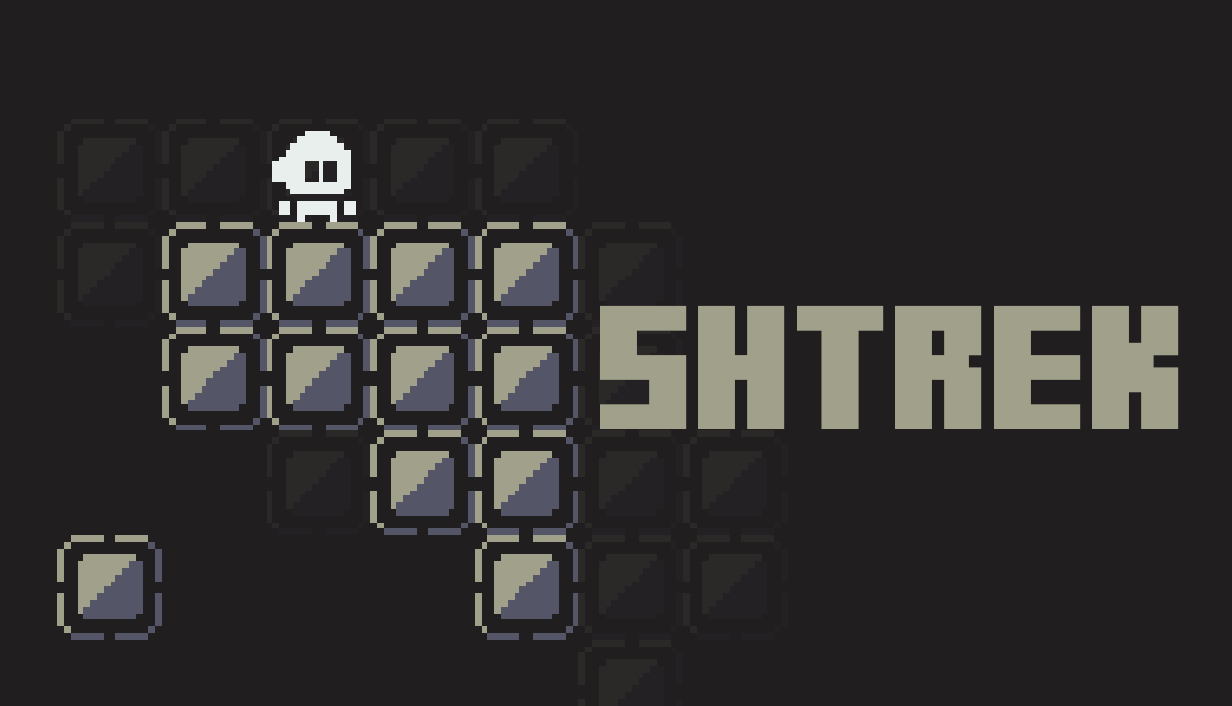
Precision platformers live or die by a simple promise: die instantly, respawn instantly, and never once feel like the game cheated you. Shtrek, the debut Steam release from Skopje-based solo developer Bojan Nikolov under the moniker Neraat, builds its entire identity around that promise. Sixty single-screen levels, sixty lives, no tutorial, no wall jumping, no side-scrolling — just a broken, pixelated world that teaches you how to survive it through the act of dying in it, over and over, until the rhythm clicks.
What makes Shtrek worth talking about isn't just the design restraint, though there's plenty of that to admire. It's the story behind it: a software developer by day who spent a year of spare evenings and sleepless nights teaching himself Unity, hand-drawing a visual style eerily reminiscent of Super Mario Bros.'s underground levels, and composing the game's minimal, atmospheric score himself, drawing on years spent in black metal and industrial bands. The result launched to a 100% positive rating on Steam and picked up a Best Solo Dev nomination at MonteGames 2025 — a quietly remarkable outcome for a project that started as little more than an attempt to finally finish something.
We sat down with Nikolov to talk about the year it took to build Shtrek, the deliberate minimalism that shaped every level, the accidental rise of its speedrunning community, and what comes next now that fatherhood has reshaped how much time he has left for game development.
Background & Development
1. InsertCoin: Who's behind Neraat - are you working solo on games, or is it a small team?
Bojan Nikolov: Neraat is me, Bojan Nikolov from Skopje, Macedonia. Software development is my profession, while game development is something I do as a hobby. At the moment, I'm working solo on my games, covering as many aspects of production as I can on my own.
2. InsertCoin: What inspired you to make a precision platformer specifically, and why the format of exactly 60 levels and 60 lives?
Bojan Nikolov: The genre came naturally, to be honest. Before settling on it, I experimented with various ideas, but the scope was always too ambitious for what I could realistically achieve at the time with my knowledge and experience. So I decided to make something simpler and, most importantly, fun to work on.
Along the way, the whole "60 levels, 60 lives" idea kind of naturally became part of the concept. Given the challenging nature of the game, I wanted lives to feel like a resource that the player has to manage, rather than just an arbitrary limit.
3. InsertCoin: How long was Shtrek in development, and what did the process look like - from the first idea to the final version?
Bojan Nikolov: Shtrek was the product of a few other prototypes that came before it, but in the form that was eventually released, development took around a year. Since game development isn't my day job, I worked on it mostly in my spare time, although it also involved quite a few sleepless nights.
Once I settled on the visual style, I moved on to level design, which was mostly done in a notebook first and then translated into Unity, where the levels went through a lot of testing and tuning.
At the same time, I was still learning many aspects of the engine, so there were plenty of roadblocks along the way. While they definitely slowed the process down, they also taught me a lot and helped me in the long run. Overall, it was an amazing experience.
Game Design
4. InsertCoin: Minimalism is very pronounced in Shtrek - both visually and mechanically. How did you decide what to cut and what to keep?
Bojan Nikolov: Minimalism came naturally. If I wanted to finally finish something, I had to limit the scope and be realistic about what the game could be. When developing games solo, it's very easy to overextend yourself and keep adding ideas beyond what you can realistically pull off.
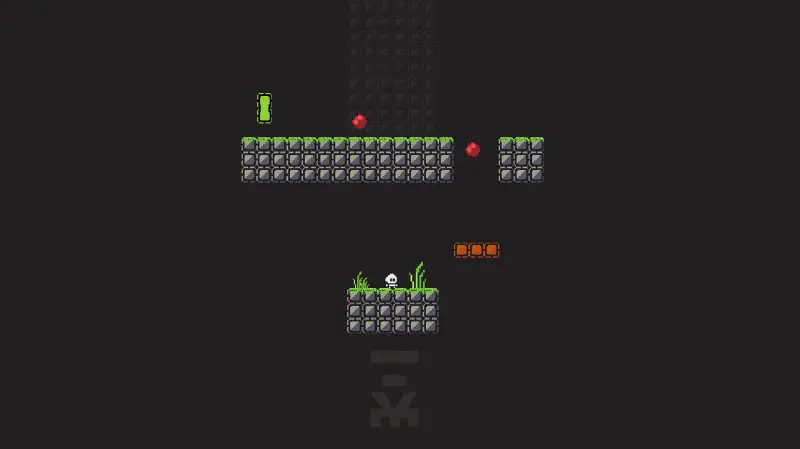
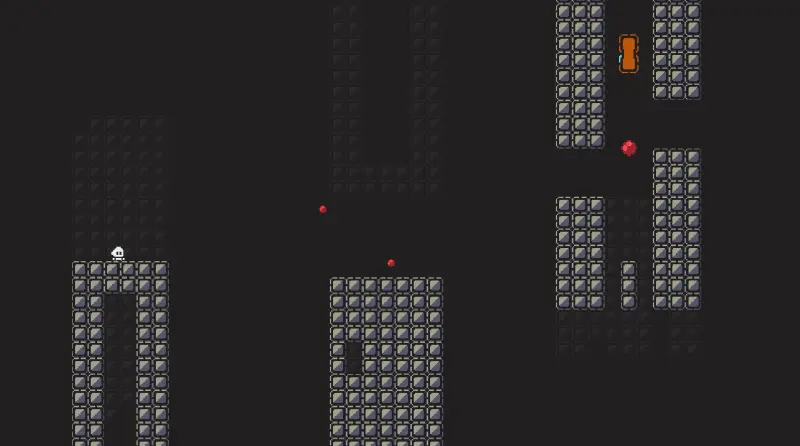
I decided to remove a lot of the mechanics and just keep things simple. It was also a fun challenge to see how much I could do with so little, and I'm really happy with how it turned out. I cut out side scrolling, contained every level to a single screen and ditched mechanics like wall jumping.
The visual style also had to be something I could actually draw and create myself. I'm no artist, so this was the best I could do at the time.
5. InsertCoin: The post-apocalyptic atmosphere combined with pixel art gives the game a distinct tone - where does that visual and thematic inspiration come from?
Bojan Nikolov: The visual theme was somewhat consciously inspired by the underground levels in Super Mario Bros., as well as the fourth level of each world. I always found those places eerie, even a little liminal. With SHTREK, I wanted to recreate some of the feelings they gave me, while making the world feel broken and abandoned.
6. InsertCoin: How did you balance the difficulty across 60 levels - did you test with other players, or did you determine the progression yourself?
Bojan Nikolov: Shtrek went through a lot of testing. From family to different circles of friends, I had it tested by pretty much everyone willing to grab a controller and give it a try. I tested it with hardcore gamers, non gamers and more casual players, and I took their feedback very seriously. That helped me tune the levels and find the right progression order.
Since there is no tutorial, I had to "teach" players what they can do and how the levels can harm them through the level design itself. Because the world is your enemy, the game had to gradually show you what you're dealing with and give you room to practice overcoming an obstacle before later combining it with others.
I think I achieved that, and I'm very happy with how the progression turned out. Of course, some levels were completely removed or redesigned based on feedback.
7. InsertCoin: Instant respawn and fast reset times are an important part of the game - how technically challenging was it to get that right?
Bojan Nikolov: This was actually one of the easiest parts. Because you may die a lot, you have to be brought back instantly. So there is no death screen, just a very quick respawn that gets you straight back into the game. Super Meat Boy did this perfectly, so I kind of stole it, haha.
Speedrunning & the Highscore Element
8. InsertCoin: The game is advertised as "speedrunner-friendly" with a highscore table - did you target the speedrun community from the start, or did that develop along the way?
Bojan Nikolov: It wasn't really imagined as "speedrunner friendly" from the beginning. That idea came during the testing phase. The implementation itself is also quite minimal. There is a hidden clock running in the background, so you're not constantly distracted by a timer or put under additional pressure.
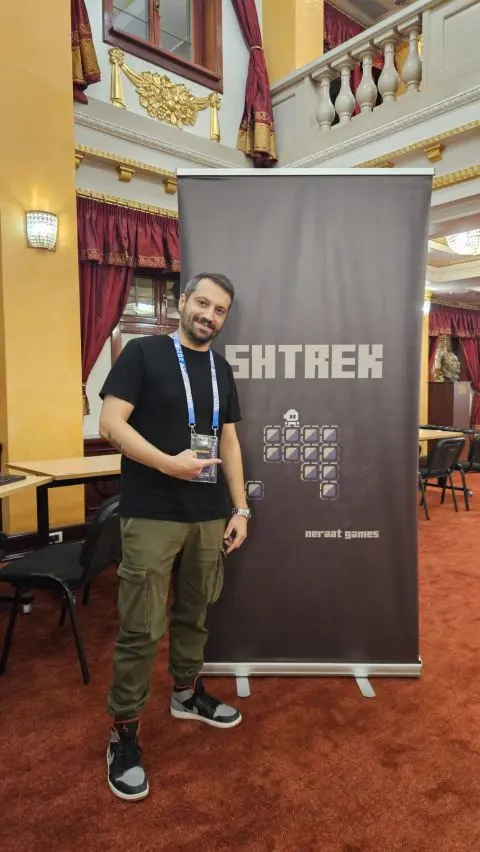
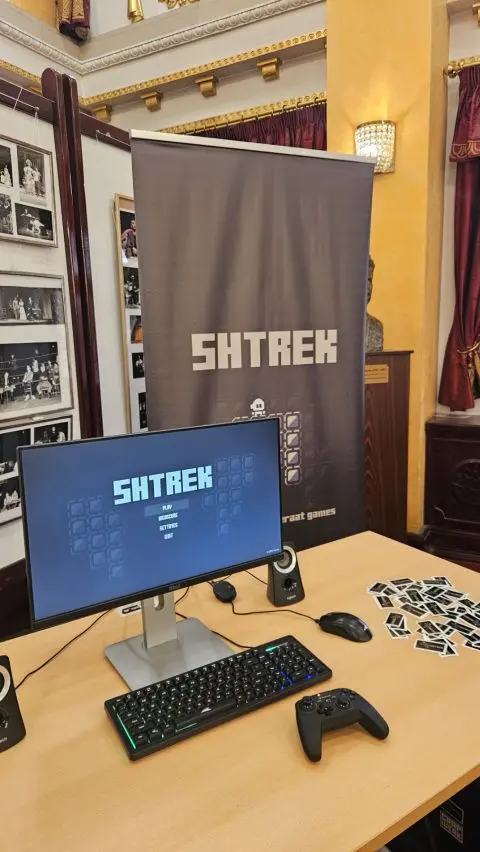
It started as a small nice to have feature that was fun to develop, but it really shined at conferences where I had a booth with the game. People would come over and keep trying to beat the high score. It was great to watch because I never imagined that would happen when I was making it.
9. InsertCoin: Are there any hidden levels or secrets you'd like our readers to discover for themselves, without spoilers?
Bojan Nikolov: There are a few secrets to be found. I'm a sucker for secrets in video games myself, so I had to put a few into Shtrek. I won't give away any spoilers, but I don't think they're too hard to find, haha.
The Player & the Experience
10. InsertCoin: Who is Shtrek mainly made for - experienced platformer players, or also newcomers to the genre despite the difficulty?
Bojan Nikolov: I think the simplicity of the game can appeal to both. It gradually builds up to the harder parts that experienced platformer players might find challenging, but I think it can hook newcomers as well. At least, that's the feedback I've been getting.
11. InsertCoin: What's the biggest "aha" moment you want players to experience while playing - the moment when everything finally "clicks"?
Bojan Nikolov: I don't think there are many traditional "aha" moments. Maybe when you discover that you have a double jump, or when you realize you can use the "coyote time" jump to your advantage and clear wider gaps. Those things are fairly easy to figure out though, usually on the first few tries.
12. InsertCoin: Did you have to clear every level yourself without mistakes to make sure they were fair, or were there moments when you "suffered" too?
Bojan Nikolov: Oh yes. Before some of the more brutal levels ever reached other testers, I had to play them over and over again myself to make sure they worked and tune them properly. I also had to place certain levels before them to ease the player into the mechanics and obstacles they would encounter later. Most of the levels are designed to be played almost rhythmically. Once you get the timing right, they become much easier to run through. You need some practice of course, but I never wanted the game to be hard just for the sake of being hard. It's definitely not one of those rage platformers.
The Technical Side
13. InsertCoin: Which engine was Shtrek made in, and why did you go with it?
Bojan Nikolov: I went with Unity. It was straightforward to use, there were plenty of resources and community support available, and it gave me the option to port the game to different platforms. Not this game though, but the next one for sure, haha.
14. InsertCoin: The music is highlighted in the description ("It's nice") - who made the soundtrack, and what was the approach to sound alongside such a minimalist visual style?
Bojan Nikolov: I did the score myself. I have some experience with creating music as well, although that's another hobby of mine. I played in black metal and industrial bands back in the day, and over the years I've also released a few dark ambient albums under the Nanohex moniker.
The music for Shtrek had to be minimal too. I didn't want it to be intrusive, but more of a backdrop that complements the atmosphere. It sounded nice to me, so I jokingly put "It's nice" in the Steam description and just kind of ran with it, haha.
15. InsertCoin: The achievements system has 19 achievements - how did you choose what gets rewarded, given how focused the gameplay is?
Bojan Nikolov: The original reason for adding achievements was honestly just that I wanted to learn how to integrate the Steam API into my game, which turned out to be a bit of a pain in the ass.
They weren't really planned as an important part of the game. They were just another part of my learning process, but once I had the system working, I wanted to actually use it. They're a bit random, to be honest. Most of them reward milestones, completion and finding secrets. I would approach achievements very differently today.
Reception & Community
16. InsertCoin: The game currently has 100% positive reviews - were you surprised by the player reaction, and is there any feedback that stuck with you in particular?
Bojan Nikolov: Yes, that's still crazy to me. I didn't really expect many reviews or any particular rating, but here we are. People seem to appreciate the simplicity, the visual style and, hopefully, feel like they're getting good value for the price. There is one review that says, "We got Shtrek before GTA VI" which gave me a good laugh, haha.
And outside of Steam reviews, Shtrek also earned me a nomination for the Yugo Game Awards in the Best Solo Dev category at the MonteGames 2025 conference. That was another completely unexpected moment and honestly just as crazy to me.
17. InsertCoin: Do you plan to add new levels or DLC based on community feedback?
Bojan Nikolov: No, I've moved on to other things. I want to keep Shtrek as it is, almost like a snapshot of my process of learning how to develop and publish a game. I think it served its purpose really well, and I'd rather take everything I learned from it into whatever comes next.
More on Neraat as a Developer
18. InsertCoin: Is Shtrek your first released game on Steam, or had you worked on something earlier?
Bojan Nikolov: Yes, it's my first released game on Steam. I made some other games before it, but nothing really worth mentioning. A few of them are still living somewhere on random itch.io accounts, but they're much more amateurish.
19. InsertCoin: How do you see the indie scene in the region - is there enough support and room for small developers like yourself?
Bojan Nikolov: I think the indie scene in the region is in a much better place than it used to be. There has probably never been a better time for someone who wants to create games. We have so many tools, resources and learning materials at our disposal, and I'm seeing awesome games of all different sizes coming out of the region more and more often. There is good local support as well. In Macedonia, there are communities where you can connect with other people and grow as a game developer, whether you want to pursue it professionally or simply as a hobby.
To Wrap Up
20. InsertCoin: What's next for Neraat - are you already working on something new, or planning further support for Shtrek (new levels, updates)?
Bojan Nikolov: Since Shtrek, I've been developing lots and lots of prototypes across different genres, trying to find the next idea that will be fun enough for me to commit to. I already have a few contenders for what the next Neraat game might be.
My spare time is much more limited now than it was when I was developing Shtrek. I became a dad, which naturally changed my priorities quite a bit. I still love making games and I try to find a few hours here and there to work on them, but spending time with my son is much more important to me than finishing another game as quickly as possible.
Since I do this for enjoyment and out of enthusiasm, there's no race for me to release something just for the sake of releasing it. I'll get to the next game eventually, and I'd rather take my time and make something I genuinely enjoy working on.

Comments (0)
Be the first to comment!
Leave a comment as a guest