
I’ve never played a game that has thrown me in more directions than Alone in the Dark. At times Eden’s ambitious survival horror game touches on brilliance, dazzles with blockbuster spectacles and revels in originality. Its problem is that these moments make up a small portion of the game – a game which suffers from almost every longstanding gaming irritant and problem I’ve written about a thousand times over. Despite wanting to love it and enjoy its many clever puzzles, disappointment, frustration and annoyance set in all too often. You play as Edward Carnby, who awakens in a fairly groggy state at the start of the game in a room with an old man (Paddington) – who soon becomes a pivotal character in the game. Strangely, Ed is the very same character from the old Alone in the Dark games, presumably sent through time to the modern day. From the off you’re asked to blink in order to clear your vision, just one of the game’s real-world gameplay mechanics which are both genius and immeasurably annoying. You’re in an apartment block overlooking Central Park, New York, and soon enough things take a turn for the worst. The building begins to break apart, fissures appear along walls and demons possess the bodies of the living. You must get out alive, and it’s here that the game’s controls become the real villain of the piece. Alone in the Dark is really a handful of games rolled into one. At times it’s a Resident Evil 4 like third-person game, but it’s also a first-person shooter, a third-person varied camera adventure game and a driving game. You’re free to switch to first-person at any time, although the game decides if the third-person view should be over the shoulder or from a cinematically placed camera. After only a few minutes it’s all too obvious that deciding against a singular view point is one of the developer’s biggest mistakes.
 The opening sections are really there for spectacle, tutorial purposes and to meet the main secondary characters (the aforementioned Paddington and Sarah, an art dealer), with the proper game not really beginning until you enter Central Park itself, but the foundations have already been laid. From a third-person viewpoint you can use melee weapons, moving the right analogue stick around to attack. Anything you can pick up can be used as a weapon, and while it’s a little clunky it works well enough. You’ll probably want to fire your gun at an incoming enemy, but you can’t do so from a third-person viewpoint. Switching to a first-person viewpoint allows you do use projectile weapons, but here the aiming is so fiddly (and the enemies are often so unpredictable) that hitting anything is harder than it looks.
Throughout the game you’ll be constantly switching between the two views, and it doesn’t make for good gameplay. A third-person over the shoulder view that also allowed for Resident Evil 4 style shooting would have been fine, as would a Condemned style first-person view that also allowed melee combat. Having both simply complicates matters. This is even before the game’s inventory system is factored in to the gameplay – something you’d assume would have little to no effect on the actual in-game action.
Your inventory in Alone in the Dark is accessed in real time by Carnby looking down into his jacket. It features slots for numerous items, with bottles, canisters and other throwable objects on the right, gun and torch in the middle, and everything else on the left. With limited space storage is always a problem, and you’ll regularly have to drop items in order to pick up others – whether it be an essential health spray or much needed bottle of fuel. You can equip one item in each hand, allowing for various combinations, and even combine items before equipping, allowing for such things as sticky bombs or Molotov cocktails.

The story and characters can’t carry the game
It’s an incredibly fiddly and tricky menu to work with, made worse by the fact that monsters can walk up and batter you while you’re trying to combine your leftover items to make something half useful. A handy ‘favourites’ system allows you to assign up to four left/right hand combinations for quick selection (a lighter in your right hand and bottle of whisky with a bandage jammed in it in the left, for example), which removes a layer of fiddling, but there are so many combinations that you’ll always be tinkering with things in your inventory. As great as the real inventory system seemed on paper and in presentations, in practice it simply doesn’t serve to improve the game. Take this situation as an example of how mind numbingly annoying the game can be at times. You’re in a lavatory, desperate for a health spray (spraying this over your wounds heals you, and yes, it’s done in real time) while just seconds away is a group of blood-thirsty crazed enemies. You set the door to the room on fire to act as a barrier, and then loot the room, hoping for that illusive white canister. You see one in a cabinet, but you’re not allowed to pick it up as the right side of your jacket is full. You haphazardly dump items on the floor, freeing up space, then return to the cabinet. For some reason you aren’t allowed to pick up the health spray until you’ve picked up everything else around it. Gahhh. The fire is about to die out and you can sense a horrific mauling. Quickly you grab the items, switch to your inventory and dump it all again. You’re now able to grab the spray. Quickly you press right on the d-pad to bring up the healing interface, press the right trigger to begin spraying and then get smashed in the face by a demon monster. You’re skull has been crushed and it’s time to try that all over again. Did I say Alone in the Dark is annoying?

You heal yourself, but the nice touches are outnumbered by problems.
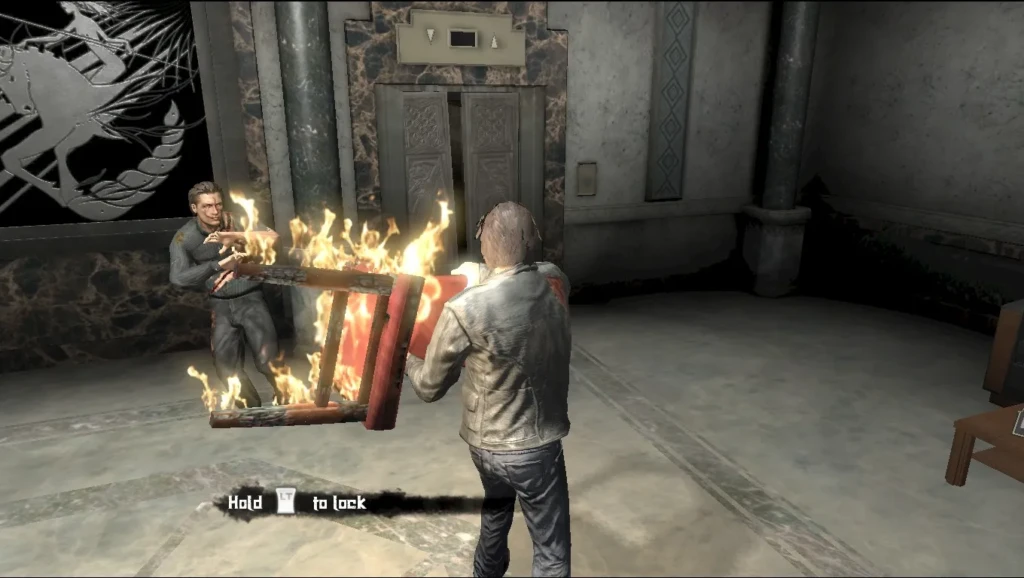
It’s so disappointing as the game’s puzzles are often brilliant. Fire plays a big part in the game and thanks to its realistic propagation across objects it reacts as you’d expect it to. That’s generally a rule that applies to most objects in the game. If you think you’d solve a puzzle a certain way if you were actually there, then chances are that’s how you solve it in the game. Electrical cable dangling in some water? No problem. Just hook the cable with a long object and move it to one side. Need something with a sharp blade? Simple. Just shoot down that sword on the wall in the museum. Need to set fire to something that is out of reach? That flaming car positioned at the bottom of what appears to be a seesaw might hold the key. You encounter clever yet logical puzzles throughout the game’s 8-10 hour duration, yet they’re simply not enough to overcome the substantial problems. Combat is frequently one of these problems. Enemies in the game are only really vulnerable to fire, which means you can’t simply shoot them in the head and be done with it. It’s pretty cool when you first encounter them, as you’re forced to set alight a chair and then swing it around like a mad man, but when you’re trying to go from point A to B in the free-roaming Central Park it’s a chore. You can combine fuel with bullets to create flaming ammo, but these still take a few shots, and combining a spray with your lighter to form a flame thrower is effective but a huge waste of resources. Home made bombs are good, but you’ll burn through them very quickly, and there aren’t all that many chairs lying around in Central Park for you to set alight. Carnby moves terribly when he’s not injured, but even slower when hurt, his turning speed in first-person is awfully slow and the camera is hopeless when you’re in third-person, often switching to a cinematic view for no real reason. When you’re not having to contend with enemies the game is far better, but they’re only ever a few minutes away. One of the more interesting enemies is the black water that overpowers Carnby if he enters it. It’s afraid of light though, so shine your torch on it and it’ll retreat, throw in a glow stick and you’ll clear a large area. However, even this is plagued by problems. Equipping and throwing a glow stick is fine, but you have to re-equip after each throw – fiddly, unnecessary annoyances like this sum up Alone in the Dark.
 Towards the end of the game, when you’ve finally got to grips with the inventory system (at least to the extent that it’s tolerable), you’re sent on a hunt for demon roots, which you need to burn. This is the first time you really need to explore the free-roaming Central Park, and it brings into play the terrible driving model that you first had to endure during a spectacular looking but terribly annoying sequence early on in the game. Sarah remarks that “This isn’t driving. This is murder”, which sums it up better than I ever could. This hunt also stretches your resources to the limit and will test your patience to breaking point. While many of the roots require some clever thinking to access, this whole section seems designed to extend what would otherwise have been a fairly short game.
Much has been made of the game’s episodic structure, but it adds very little to the experience. Being able to skip through to later parts is fine (although not past the root hunting), but why would you want to? Its only real use is to access parts you enjoyed so you can play through them again. It’s all presented nicely, with “previously on Alone in the Dark” montages greeting you before you play, but it’s nothing more than another bullet point feature on the pack of the box. It would have been far preferable to play a game that featured impressive storytelling and voice acting, but this area of the game felt severely lacking. The story is decent enough, but the voice acting and on-screen portrayals aren’t great.
Carnby looks nothing like he does on the game’s cover art, instead appearing to be a 70-year-old, and all the characters swear as if trying to be cool in the school playground. Despite the impressive tech on display, characters have that plastic sheen that we saw an awful lot during the first year the Xbox 360 was on the market. It’s certainly a next-gen title, sporting some impressive lighting and fire effects, and detailed environments, but animations are poor and the Xbox 360 game suffers from a sporadic frame rate and some ugly screen tearing. This isn’t an issue when playing the game on a high-end PC, but there you have to contend with the awful keyboard and mouse controls unless you have a gamepad.
 Your quick select favourites are a god send, but the inventory is still fiddly to use.
For a game set in an eerie looking Central Park, with monsters around every corner, Alone in the Dark isn’t really very scary. You’d assume this would be a given. You even have the trademark torch that runs out of batteries, yet there are few scares. When a monster lands on the roof of your car for the first time you might jump, but then when you’ve seen another magically fly 100 metres in order to do so it ruins the mood somewhat. There’s a constant fear of death, but this isn’t down to the setting but the inevitable fumbling in your inventory. One of the scariest moments occurred early on when Carnby appeared to be having some kind of seizure, his body uncontrollably gyrating on the spot. Alas, this was a bug, just one of many that occurred during my play through of the game. Atari’s ambitious next-gen take on Alone in the Dark is packed full with potential. It has more than enough good ideas to make a brilliant, must-own game, but features even more bad game design and gameplay issues. As such it’s without doubt the biggest disappointment this generation of consoles has seen and a game that’s impossible to recommend. With the PS3 game not due out for a few months, we can only hope that Atari takes the time to deliver the game this should have been.

Comments (0)
Be the first to comment!
Leave a comment as a guest